Skip to content 
HTTP vs HTTPS
Concepts
- HTTP (HyperText Transfer Protocol) is the foundational application-layer protocol used for web communication. It follows a request-response model where the browser sends a request and the server returns a response.
- HTTPS (HyperText Transfer Protocol Secure) is the secure version of HTTP. It adds an SSL/TLS layer on top of HTTP so communication can be encrypted, authenticated, and protected against tampering.
Default ports
- HTTP uses port
80by default. - HTTPS uses port
443by default.
These ports can be omitted in a URL when the default port is being used.
Connection model
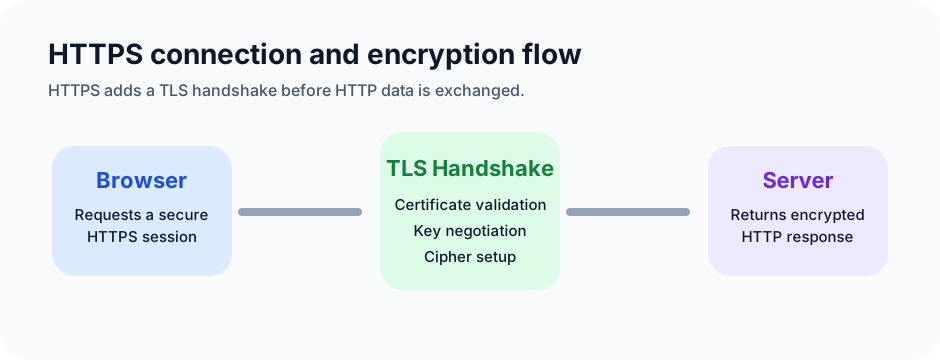
- HTTP sends data in plaintext over a TCP connection.
- HTTPS first establishes a TLS connection, validates the server certificate, negotiates encryption parameters, and only then sends the HTTP request securely.
Typical use cases
HTTP
- general public content such as blogs or documentation
- low-risk internal testing environments
- data that is not sensitive
- performance-focused scenarios where security is intentionally not required
HTTPS
- e-commerce, finance, and payment systems
- login and identity workflows
- websites carrying user privacy data
- management systems and sensitive internal tools
- any modern public production site where security is expected
Security
Confidentiality
- HTTP transmits data in plaintext, so it can be intercepted more easily.
- HTTPS encrypts data over SSL/TLS, making direct interception far more difficult.
Integrity
- HTTP has no built-in protection against tampering in transit.
- HTTPS uses cryptographic mechanisms to ensure that data is not silently modified on the way.
Authentication
- HTTP has no built-in server identity verification.
- HTTPS uses certificates and the TLS handshake to verify that the client is talking to the intended server.
Certificates
- HTTP does not use certificates.
- HTTPS relies on digital certificates issued by trusted certificate authorities, or by an internal trust chain in private environments.
Performance
Handshake and encryption cost
- HTTP avoids encryption overhead, so the connection setup is simpler.
- HTTPS adds TLS negotiation and encryption cost, especially on the first connection.
That said, modern hardware, TLS optimizations, and connection reuse have made this overhead much smaller than it used to be.
Caching
- HTTP can be cached easily by browsers and intermediary proxies.
- HTTPS can also be cached, but some intermediary caching behavior is more constrained because the traffic is encrypted.
HTTP/2 and multiplexing
- HTTP/1.1 is more vulnerable to request serialization issues and older connection constraints.
- HTTPS is commonly paired with HTTP/2 or newer protocols, which support multiplexing and better concurrency.
CDN and optimization
Both protocols can benefit from caching, CDN placement, compression, and transport optimization. In practice, modern performance optimization is fully compatible with HTTPS.
Summary
HTTP is simpler, but it is no longer the right default for public-facing systems. HTTPS provides confidentiality, integrity, and authentication, which makes it the standard for modern web delivery.
If the question is which one you should use in a real product, the answer is almost always HTTPS.